Health Care Merger Places Hawai‘i’s Well-Being at Risk
Hawai‘i already struggles with some of the highest health care costs in the nation. Families, kūpuna, and small businesses are doing everything they can to keep up. At The Queen’s Health Systems, we believe strongly that a merger between HMSA and Hawaii Pacific Health (HPH) raises serious and immediate concerns for all Hawai‘i residents.
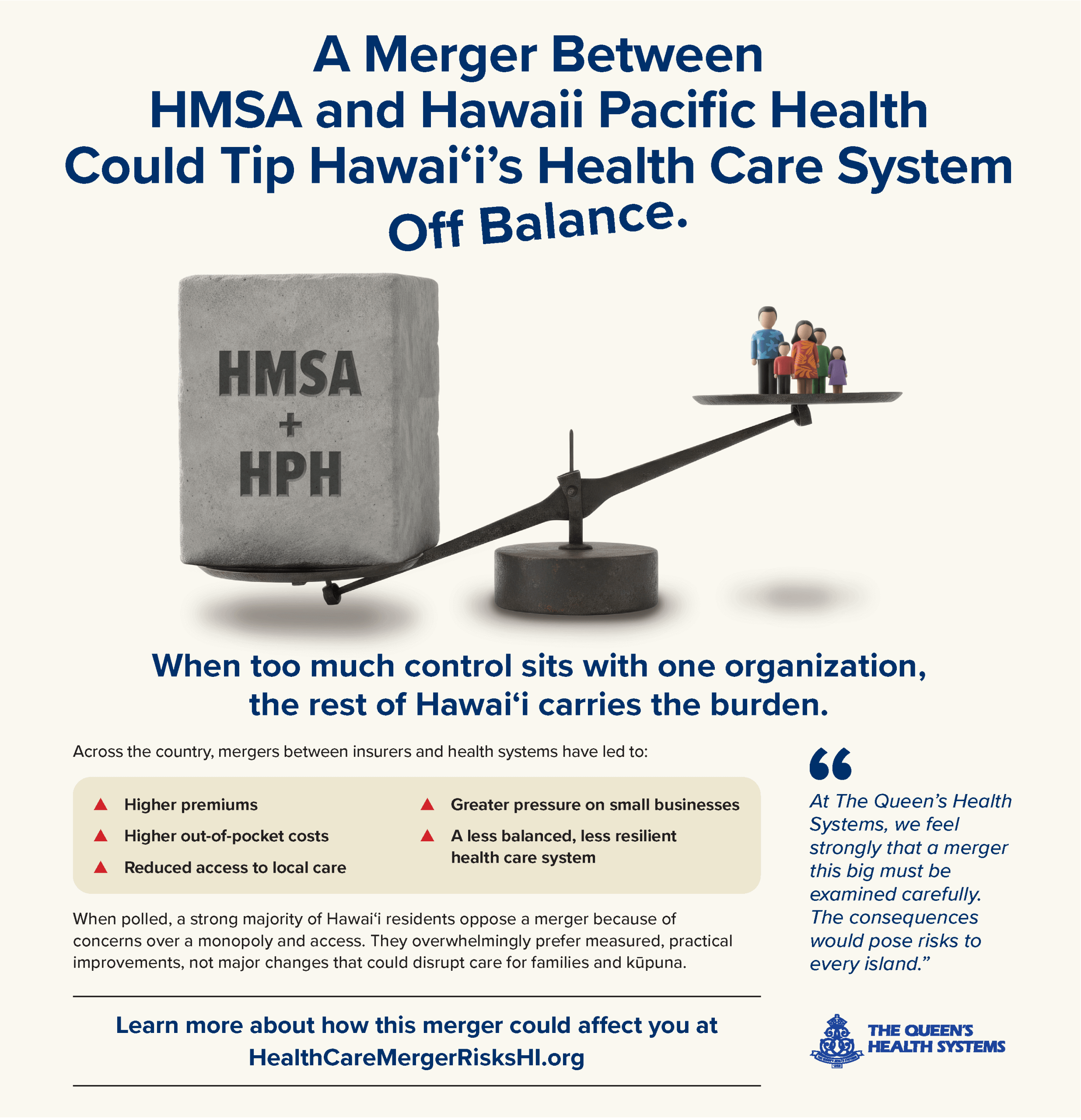
Experience from other states shows that when insurers and care providers merge, costs rise, access narrows, and the community ultimately loses. And when one entity gains control over both the financing and delivery of care, critical services can be pulled away from the hospitals that depend on them to stay open. These are exactly the kind of unintended consequence other states have seen.
The risk isn’t theoretical. Hawai‘i’s independent hospitals and rural communities could be placed under new financial pressure. Small businesses could face premium increases they cannot absorb. Families could see fewer local care options as decisions move farther away from the community and closer to a single corporate structure.
When polled, a strong majority of Hawai‘i residents oppose a merger because of concerns over a monopoly and access. They prefer steady, practical improvements, not major changes that could disrupt access to care or place essential services in jeopardy. A merger of this scale could alter our health care landscape for decades.
Before any decision is made, Hawai‘i deserves a full, independent review that asks hard questions and puts the needs of our community first.
A decision this big should strengthen our entire health system. It should not favor one part at the expense of all others.
In 1859, Queen Emma and King Kamehameha IV set us on a mission to improve the health of Native Hawaiians and all the people of Hawai‘i. For more than 165 years since then, Queen’s providers and staff have been dedicated to upholding their legacy and carrying on this vital work. Our founders’ compassion and commitment set the lens through which we view changes affecting the well-being of our state’s residents. Looking through that lens today, we foresee that if the proposed HMSA-HPH merger were allowed to happen, the people of Hawai‘i would experience higher health care costs, less choice, and a widened inequality in health outcomes.
We think this proposed merger needs to be considered with great care, and our communities deserve to fully understand its likely consequences. Given our state’s already high cost of living, our leaders need to assess the economic impact this merger would have on our entire population, especially at a time when Hawai‘i businesses are struggling to attract and retain talent, our aging population needs and deserves top-quality health care, and the federal government is making troubling changes to Medicare and Medicaid.
The Queen’s Health Systems serves as the primary safety net for medical practitioners throughout Hawai‘i. In situations when other providers cannot manage a patient’s care on their own, sending the patient to Queen’s is often the first – and sometimes only – alternative.
Accepting these patients aligns with our 165-year-old mission to improve the health and well-being of all the people of Hawai‘i, and it is in this spirit that we call attention to the risks of the proposed HMSA-HPH merger. Approving the merger will weaken the state’s health care system, raising costs, eroding quality and reducing competition with effects that disproportionately disadvantage the poor, kūpuna and Native Hawaiians. These impacts will be exacerbated further if the Trump Administration’s “Big Beautiful Bill” drives people out of the Medicare and Medicaid systems, as many are forecasting.
News Coverage
Stay up to date on the latest news coverage about the merger between HMSA and Hawaii Pacific Health (HPH).
News Articles
Stay up to date on the latest news coverage about the potential merger between HMSA and Hawaii Pacific Health (HPH).


(Subscription may be required)


(Subscription may be required)


Frequently Asked Questions
General Questions
Why is QHS taking a public stand on this merger?
As the state’s leading safety-net health system, we are deeply invested in the health and well-being of all the people of Hawai‘i. We cannot stand by while a merger threatens to raise health care costs, reduce patient choice, and widen disparities, especially for Native Hawaiians and those who depend on Medicare and Medicaid. Speaking up is our kuleana.
Isn’t this merger a private business decision?
On the surface, yes, but its consequences will affect everyone in Hawai‘i. If the merger is approved, it could erode health care access and affordability across the state, impacting employees, patients, providers, and businesses alike. That makes it everyone’s business.
FAQs For QHS Employees
Why should I care about a merger between HMSA and HPH?
The merger could weaken health care access for those who rely on QHS most—including the patients we serve every day. It may also reduce reimbursement rates and limit where patients can seek care, ultimately putting more pressure on QHS to absorb complex cases without added resources.
Is QHS opposing the merger out of competitive self-interest?
Our position is driven by our royal mission. We exist to serve all the people of Hawai‘i, especially the most vulnerable. When we see a development that could raise costs, reduce access and deepen disparities, we are obligated to raise our voice.
What’s expected of me as a QHS employee?
You’re encouraged to stay informed, ask questions and share your perspective with your ‘ohana, friends and community leaders. If you support our position, please add your voice to the broader conversation.
FAQs For Hawai‘i Business Leaders
What does this merger mean for my company and employees?
It likely means fewer choices and higher costs. With HMSA and HPH under one roof, the new entity will have incentives to steer patients exclusively to its own facilities, removing competition and raising prices. That translates to higher premiums, narrower networks and more difficulty for Hawai‘i businesses struggling to attract and retain talent here.
Isn’t integration good for efficiency and innovation?
That depends on who benefits. While business integration can improve internal performance, in this case, the risks to employers who buy insurance for their workforce may far outweigh the benefits to the two companies wishing to merge. As competition decreases, cost control and service responsiveness typically suffer.
What can I do about this?
Speak up. Contact the governor. Engage in dialogue with other business leaders. This is a moment to help shape the future of health care access and affordability in our state.
FAQs For Community Leaders
Why is this merger bad for the community?
Unlike Kaiser Permanente, which was intentionally built as an integrated system with aligned incentives from the ground up, this merger would combine two dominant players that have historically operated separately: HMSA as the state’s largest insurer and HPH as one of its largest hospital systems. Bringing them under one roof now, without clear safeguards, would concentrate market power in ways that could raise prices, reduce transparency, and limit patient choice. That’s especially dangerous in Hawai‘i, where health care costs are already high, and vulnerable communities, including Native Hawaiians, kūpuna, and those relying on Medicare and Medicaid, could be disproportionately harmed.
Couldn’t the proposed merger increase efficiency or improve care?
Possibly for the two companies seeking to merge, but not necessarily for the people of Hawai‘i. The incentives may shift from serving communities to maximizing organizational control. Patients could be directed to specific hospitals without being told about better or more affordable alternatives.
What’s the broader economic impact?
Hawai‘i already has the nation’s highest cost of living. Raising health care costs and restricting access will make the state even less affordable, fueling outmigration and weakening our social fabric.
FAQs For Advocacy Groups
How might this merger affect the communities we advocate for?
Negatively. Vulnerable populations—especially Native Hawaiians, kūpuna and those on Medicare and Medicaid—will likely bear the brunt of rising costs and restricted access. The merger could deepen already unacceptable gaps in care.
What concerns should we raise publicly?
Call attention to the potential for diminished access, worsening health disparities and reduced community accountability. Ask who will hold the combined entity responsible when affordability or quality slip.
Does QHS support alternatives?
Yes. We support efforts that expand access, lower costs and improve care coordination without concentrating power in ways that limit transparency and harm the people of Hawai‘i.
FAQs For Labor Union Leaders
How would this merger affect health care workers?
By reducing competition among employers, the merger could suppress wages, narrow job opportunities and reduce collective bargaining leverage. It also risks increasing pressure on safety-net systems like QHS, where unionized workers will be asked to do more with less.
What does this mean for union-covered patients?
Many union members rely on HMSA for insurance, and they value being able to choose their providers. A merged system could limit those options and increase out-of-pocket costs, especially since HMSA will have strong incentives to direct patients to HPH facilities.
What role can unions play in opposing the merger?
A powerful one. Labor unions are trusted community voices and critical protectors of working families. We urge union leaders to publicly oppose the proposed merger, demand transparency and advocate for health equity and affordability.
Voice Your Concerns
Fill out the form below to share your concerns about the merger between HMSA and Hawaii Pacific Health (HPH). We will not post or share your concerns publicly without your permission.
