









Hospital-Acquired Pressure Injuries (HAPI)
A pressure injury (also called a pressure sore) happens when skin and the tissue under it are damaged by staying in one position too long. These injuries often happen over bony areas like the tailbone, heels, hips, and elbows. They can be painful and may lead to infection if not prevented or treated early.
Pressure injuries are common in hospitals, especially for people who have trouble moving, have poor blood flow, or are very sick. Preventing them takes a team effort and a clear plan.
What Increases the Risk of a Pressure Injury?
Many things can raise the risk of a pressure injury. The good news is that most risks can be lowered with the right care.
Common risk factors
- Trouble moving or turning in bed or a chair.
- Less feeling in the skin or nerve problems.
- Moist skin from incontinence or heavy sweating.
- Poor nutrition or not drinking enough fluids.
- Medical devices pressing on the skin (for example, oxygen tubing or braces).
- Serious illness, poor circulation, or low oxygen levels.
How Is The Queen’s Health Systems Performing Compared to the Nation?
At The Queen’s Medical Center, Quality & Patient Safety monitors pressure injury performance using PSI‑03: Hospital-Acquired Pressure Ulcer, a Patient Safety Indicator developed by AHRQ. PSI‑03 identifies serious pressure injuries (stage III or above) that develop during hospitalization and is widely used as a national measure of hospital quality and patient safety.
Quality and Patient Safety reports the rate of PSI‑03 events and compares it to national benchmarks for similar hospitals. These comparisons allow Queen’s to evaluate performance, identify opportunities for improvement, and ensure continued delivery of high-quality, safe patient care. The organizational target is aligned with national AHRQ and CMS performance expectations for PSI‑03.
Data
Lower is Better
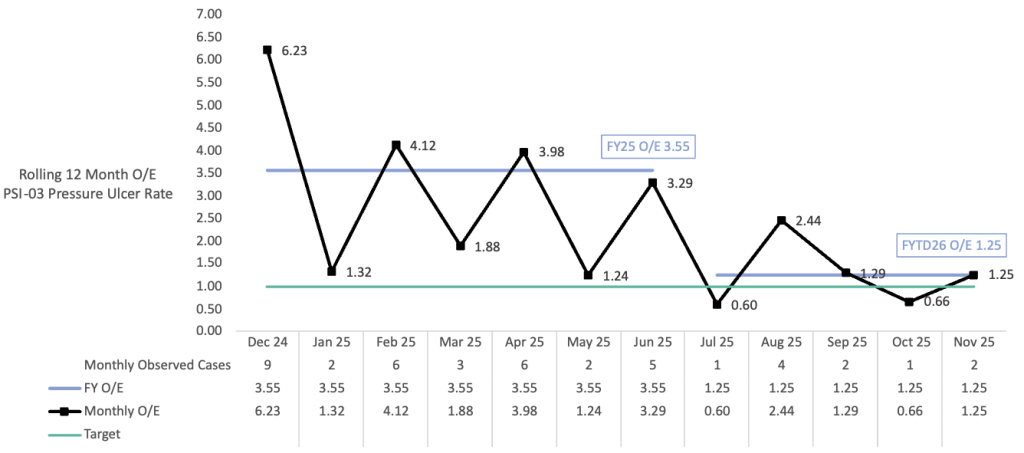
Queens Overall Graph Explanation
The line chart shows the PSI-03 Pressure Ulcer Rate Observed to Expected Ratio for The Queens Medical Center. The target ratio if less than or equal to 1. FY 25 saw a ratio of 3.55 which was improved in FYTD 26 with a ratio of 1.25.
| FY 25 | FYTD 26 | FY26 Target Performance Measurement Period | Target | |
|---|---|---|---|---|
| PSI-03 Pressure Ulcer Rate Observed to Expected Ratio | 3.55 | 1.25 (Jul-Nov) | (04/01 - 06/30) | O:E ≤ 1.00 |
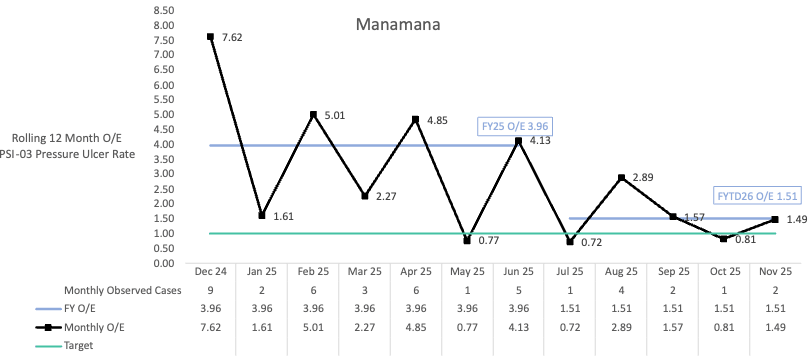
Manamana Graph Explanation
The line chart shows the PSI-03 Pressure Ulcer Rate Observed to Expected Ratio for The Queens Medical Center – Manamana/Punchbowl. The target ratio if less than or equal to 1. FY 25 saw a ratio of 3.96 which was improved in FYTD 26 with a ratio of 1.51.
West Oahu Graph Explanation
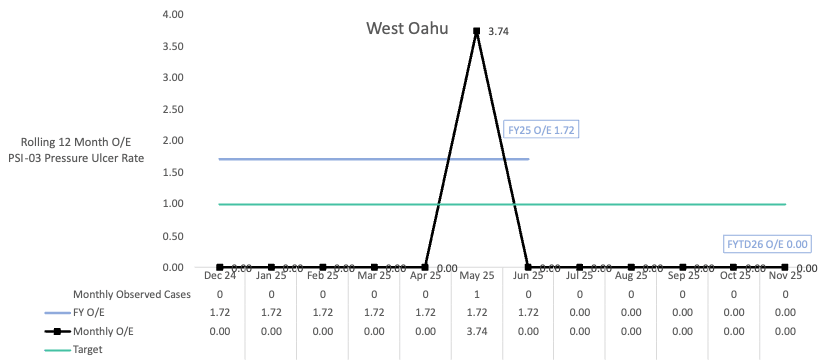
The line chart shows the PSI-03 Pressure Ulcer Rate Observed to Expected Ratio for The Queens Medical Center – West Oahu. The target ratio if less than or equal to 1. FY 25 saw a single case in May, with a ratio of 1.72, but FYTD 26 saw no cases leaving a ratio of 0.

QNHCH Graph Explanation
The line chart shows the PSI-03 Pressure Ulcer Rate Observed to Expected Ratio for The Queens Medical Center – North Hawaii Community Hospital. The target ratio if less than or equal to 1. FY 25 saw no cases with a ratio of 2.27 and FYTD 26 saw no cases with a ratio of 0.
Molokai Graph Explanation
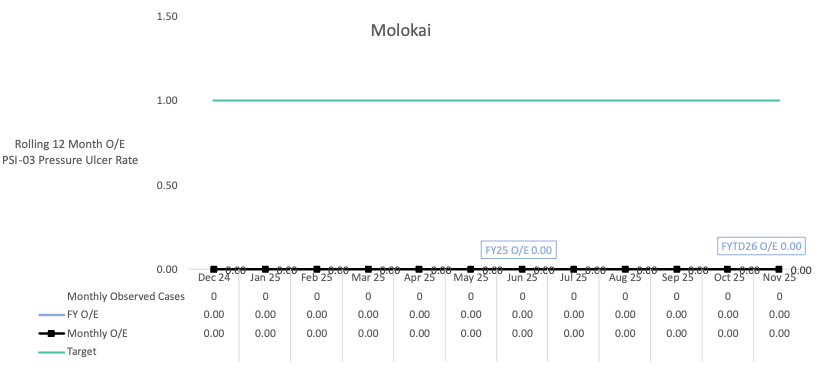
The line chart shows the PSI-03 Pressure Ulcer Rate Observed to Expected Ratio for The Queens Medical Center – Molokai. The target ratio if less than or equal to 1. Both FY 25 and FYTD 26 saw no cases and both had a ratio of 0.
What Are We Doing to Prevent Pressure Injuries?
Our teams follow current national evidence-based practices as a part of daily care for every patient.
- We check your risk early and often, using a validated tool when you arrive and throughout your stay to find your risk and build a plan.
- We check your skin regularly; on admission and each shift, paying special attention to heels, tailbone, and under medical devices.
- We repositioning you to relieve pressure if you can’t move on your own. The staff will help change your position every 2 hours in bed (and more often as needed).
- We use pressure relieving surfaces like special mattresses, cushions, and heel protectors to spread out pressure and protect your skin.
- We use protective dressings on high-risk areas like the heels or tailbone to reduce rubbing and pressure.
- We provide moisture and skin care by gently cleaning the skin, then applying moisture barrier creams after incontinence.
- We monitor your nutrition and hydration to make sure your skin stays healthy. Dietitians get involved when needed.
- We review every pressure injury case with a team from different specialties to review what happened and to improve our care.
We are honored to care for you and committed to supporting your physical, emotional, and overall wellbeing throughout your stay.